
The Sense of a Beginning
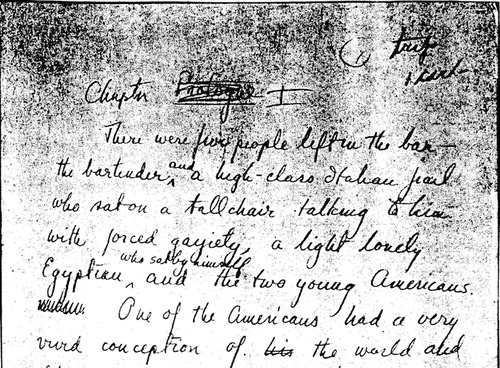
I am writing an essay or story or a book (it doesn’t really matter which and I’m not sure I myself know which yet) and I need a first line, something to launch the thing; something that will hook the reader; something, perhaps even more crucially, that will hook me; something that will get me started and keep me going.
But I can’t get started. (I should say there’s a famous song of that name, written in 1936, the same year much of what I want to write about transpires.) So I’m thinking of great first sentences: Ford Madox Ford’s “This is the saddest story I’ve ever heard”; Bellow’s “I am an American, Chicago-born…”; Dickens’ “LONDON. Michaelmas Term lately over, and the Lord Chancellor sitting in Lincoln’s Inn Hall. Implacable November weather”; Nabakov’s “Nobody likes a smart-ass”. I could go on, but, as I say, I can’t, not just yet.*
So, how to begin? Ford has the most blatant hook: who doesn’t want to know what the saddest story is? Bellow seems to be promising an epic, maybe Melvillian, maybe picaresque too, but either way you say “let’s find out”. Dickens’ opener runs for a page or more, fragment after fragment of London atmosphere, fug and fog. He seems to have changed my question (by now my worry, my affliction, my inquisitor with kindling and matches to hand) from how to begin to where to begin, and perhaps that’s the better question; it’s how most of us introduce a story we’re going to tell in a matter-of-fact way. There’s a moment of sorting through, of finding the best point in the chronology to start, as though the aptest moment is a locatable and habitable place, somewhere hospitable for the narrative to set out from or perhaps to simply hang its hat. Whereas when I say “how to begin?” I feel at a bit of a loss, fumbling towards an explanation, even an apology, for a sequence of events which isn’t quite graspable or explicable or even defensible; not yet anyway, not with these words, not from this place.
But I will try geography. And I came up with this: “It will always be one town or another so it might as well have been Asheville.” It’s not too shabby, I think. It gets us to Asheville, where most of what I want to write about takes place, but the “one town or another” suggests the things that happened in Asheville are universal, even significant. It raises a lot of questions and perhaps a reader will be inclined to stick around for answers. More important for me, it invokes–maybe secretly, maybe just for me–sentences from writers I love, Richard Hugo and F. Scott Fitzgerald: “whatever river, whatever town–it is much the same” (Hugo, “The Towns We Know and Leave Behind, The Rivers We Carry With Us”); “in any case he is almost certainly in that section of the country, in one town or another” (Fitzgerald, Tender is the Night). I can press forward in their company. They’ll watch over me. Now I’m ready.
Of course I know from experience that, as likely as not, that this may not be the first sentence, or not for long. It might be that I find another or strike the first and let the one that followed it stand in its place, that one being what I really want to say. Or–and this has happened many times–it ends up being the first sentence of the second paragraph because I might discover that the whole first paragraph was merely throat-clearing, adjusting to the temperature of the piece; scaffolding that, once the frame was somewhat stabilized, I could dispense with.
Sometimes this even happens at the level of the chapter. In my second book I wrote a whole new first chapter after the I’d finished (or thought I’d finished) the complete manuscript, and slid it in front of the original. As far as I know, no one’s the wiser. F. Scott Fitzgerald had done the same thing in Tender is the Night. That novel took nine years to write and for the first five of them, the page you see at the top of this post was its beginning. Then Fitzgerald moved chapter two (see below) to the front and shunted a truncated version of what had been the opening scene into the center of the book. It was, to be sure, a different book–scarcely the one Fitzgerald imagined he was writing at the start–and who can say that it had everything to do with the intent of that sentence and very little to do with Fitzgerald’s?
So we shall see. Stay tuned.
* By the way, the Nabakov/Lolita opener–I made that up but think it’s awfully good.


